
Never Put Them Out of Your Heart
This is a reflection on the quiet discipline of keeping the heart open, even when love must take a different form.
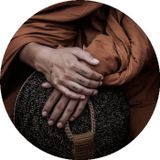
Ram Dass once said something that stayed with me for many years: “Do what you do with another person, but never put them out of your heart.”
It took me a long time to understand the depth of that.
There comes a point in some relationships when the behavior of another person requires a boundary. Sometimes a very clear boundary. Sometimes even a physical separation.
There are moments when taking care of ourselves means saying no more. It means stepping away. It means refusing to continue participating in something that is harmful, destructive, manipulative, or simply no longer bearable.
There is nothing unloving about that. Love does not require us to remain available to behavior that wounds us.
But there is something else.
When the boundary is first made, it is often made in the midst of anger, fear, grief, disappointment, or resentment. Perhaps those feelings are exactly what finally gave us the strength to say enough. And for a while, they may even be necessary.
But eventually another invitation appears.
Although the person may no longer be standing in front of us, what happened between us can continue living inside us. The relationship has ended outwardly, but inwardly it continues.
The arguments continue. The accusations continue. The hurt continues.
We replay what happened. We imagine what we should have said. We prosecute the case again and again in the courtroom of the mind.
And gradually we begin to see something very important: the boundary may be protecting us, but the resentment is not.
The boundary can remain, but the anger no longer needs to.
When resentment is carried long enough, it begins to contaminate the very system we were trying to protect. It casts a shadow across our own heart.
We may have removed ourselves from the source of the wound, yet we continue carrying the wound with us.
And so the work changes.
The work is no longer about changing the other person. It is no longer about getting them to understand. It is no longer about receiving the apology that may never come.
The work becomes finding our way home inside ourselves.
We begin to move beneath the anger, beneath the fear, beneath the grief, beneath the resentment.
Not by denying any of them. Not by pretending that what happened did not matter. Not by creating some spiritual story in which harmful behavior suddenly becomes acceptable.
But by allowing what has been held inside us to move. To loosen. To complete itself. To return, perhaps, to the great universe from which everything comes and to which everything eventually returns.
And underneath all of that, something remains.
The heart.
The heart that was there before the injury. The heart that was there during the conflict. The heart that was there even when we could no longer feel it.
We discover that we can love someone without allowing them back into our lives.
This is one of the great misunderstandings about forgiveness and compassion. To forgive inwardly does not necessarily mean to reconcile outwardly.
The door may remain closed. The boundary may remain exactly where it is. The phone may never ring again.
And still, the heart can open.
I do not have to let you back into my life in order to let you back into my heart.
Perhaps this is what Ram Dass was pointing toward.
Do what must be done. Leave if you must leave. Protect yourself if you must protect yourself. Say no when no is required.
But do not make a permanent home for another person in the darkness of your resentment.
Because at the deepest level, something even more mysterious begins to reveal itself.
There really is only one of us here.
We appear as separate beings, living separate lives, carrying separate histories. And on the human level those distinctions are real and must be respected.
But beneath them is something indivisible.
One life. One field. One heart appearing through billions of forms.
And so when I release another from the prison I have constructed for them inside myself, something more happens than my own healing.
I become freer. And somehow, mysteriously, so do they.
Not because I have changed their behavior. Not because they even know that anything has happened.
But because wherever separation is relinquished, even in one human heart, there is a little less separation in the world.
Wherever hatred ends, something in the whole is healed. Wherever resentment is released, love has a little more room to move.
This does not happen all at once. Some wounds take years.
Some people may need to be released from the heart a thousand times before we discover that we are no longer holding them there.
That is all right. We simply continue.
Again and again, we find our way beneath the story and back toward the place in us that was never wounded.
And perhaps, eventually, we can think of the person who once caused us so much pain and discover something astonishing.
Nothing tightens. Nothing needs to be defended. Nothing needs to be resolved.
There is simply space.
And perhaps even tenderness.
The boundary is still there, but the wall inside us is gone.
This is how the heart becomes free.
And because there is, ultimately, only one heart, perhaps no heart is ever freed alone.
Every time one of us releases hatred, resentment, or bitterness, something is returned to the whole. Something becomes lighter. Something becomes possible that was not possible before.
We have contributed, in our small and invisible way, to the liberation of the human heart.
So do what you must do with another person. Set the boundary. Walk away when walking away is necessary. Protect this precious life you have been given.
But when the time comes, find your way back through the anger, through the grief, through the fear.
Find your way home.
And never put them out of your heart.
Nigel Lott teaandzen.org
Meditation Sans Frontieres 501 (C) 3 Registered Charity Tax EIN 81-3411835
May the work offered here serve peace, serve healing, serve remembrance, and serve the quiet dignity of being alive. May this sanctuary belong not to one person alone, but to the field of life itself.
And may all who encounter it feel, even for a moment, that nothing is missing and they are not alone.
 TEA AND ZEN