DARKNESS AND LIGHT
Al-Anon and Beyond
An essay for students on the original wound, the addiction to suffering, and the return to Love.
There comes a moment on the path — usually after many years, and sometimes after many lives — when we begin to see something with startling clarity: that much of what we have called “spiritual work” has not actually been a movement toward God, or Love, or Truth… but a movement back toward pain.
Not because we enjoy suffering.
Not because we want darkness.
But because somewhere in the early shaping of our inner life, suffering became our default position — our familiar territory, our emotional homeland. We did not choose it consciously. We simply awakened inside it.
And in that place, we began to search.
We began to search for love.
For home.
For belonging.
For the feeling of being held by Life.
But here is the tragedy — and also the deep mystery:
we searched for home in the same place we believed we had lost it.
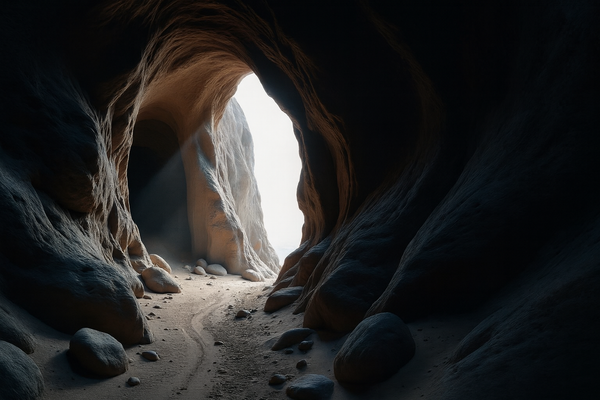
We returned to the darkness over and over again, like pilgrims trying to find God in a cave.
The Original Wound: “I Am Separate from Love”
At the root of much human suffering is what I call the original wound. It is not personal, though it becomes personal. It is not psychological alone, though it affects the psyche profoundly.
It is the moment — subtle, early, almost preverbal — when we accept the belief:
“I am separate from Love, from Home"
This belief is the foundation of what we experience as exile.
It creates the sense that we are alone inside ourselves. That we are outside the gates of life. That Love is for others, but not for us. That belonging must be earned. That safety must be negotiated. That peace is fragile and temporary.
And once this belief enters our being, the nervous system begins to orient around threat. We live in a kind of vigilant contraction. Even joy becomes suspicious, because it cannot be trusted to stay.
Pain then becomes the primary landscape of our identity. We do not simply feel pain — we inhabit it.
Why We Keep Returning to the Pain
Here is where it gets subtle.
Because if Love feels distant, and pain feels constant, the psyche performs a strange and deeply human move:
It begins to seek Love inside the pain.
It says:
“If Love exists at all, it must be hidden in the darkness.
If Home exists, it must be found in the suffering.
If I can just go deep enough, I will reach the Light.”
And so we return. Again and again.
We revisit old wounds.
We replay old memories.
We enter old relational patterns.
We choose situations that reproduce our early pain.
We find ourselves drawn toward people and experiences that intensify the feeling of exile.
And we tell ourselves it is growth.
Sometimes it is.
But sometimes it is simply the continuation of the original misunderstanding:
that Love must be earned through suffering,
and can only be found once darkness has been transformed.
I spent years living inside that orientation.
I became, in some ways, a spiritual alchemist — always working to turn darkness into light, always believing that if I could finally transform the pain, I would at last become lovable, and finally be allowed to rest.
And there is a certain nobility in this.
There is courage in it.
There is devotion in it.
But it becomes exhausting.
Because when the “darkness to light” pathway becomes our only door, we never stop entering the cave.
When Love Appears… and We Reject It
The most heartbreaking part of this pattern is that when Love actually arrives, we often cannot receive it.
And we don’t reject it because we don’t want it.
We reject it because it threatens the identity built around pain.
Love comes near, and suddenly we feel exposed.
Love comes near, and suddenly the wound becomes visible.
Love comes near, and the deep places inside that have never been held begin to tremble.
So rather than feeling comfort, we feel danger.
Rather than feeling warmth, we feel panic.
Rather than feeling relief, we feel something like shame — the shame of being seen, the shame of being touched in the place we cannot yet bear to touch ourselves.
And so we push love away.
We find fault.
We become suspicious.
We retreat.
We invalidate the tenderness.
We return to the familiar cold.
This is not because we are broken.
It is because the nervous system has been trained to interpret pain as truth.
A Further Layer: Seeking Partners I Could Fix
As I deepened into this inquiry, I began to see another strand of the same pattern — one that shaped many of my relationships.
I would often find partners — not only romantic partners, but friends and companions as well — who carried wounds I could help with. I was drawn, almost magnetically, to what was fragmented, struggling, or unresolved.
And I would love them through their brokenness, believing that if I could help return them to wholeness, they would finally recognize their own loving nature — and then love me from that place.
It was a hidden bargain:
I will help you become whole, and then you will finally give me what I have not been able to give myself.
This is one of the most subtle traps of the healing path: we confuse transformation with love, and unconsciously turn relationship into a spiritual economy.
I heal you → you love me → I become lovable → I can love myself.
But this is not truly love. It is love mixed with survival. It is devotion mixed with fear. It is service mixed with an unspoken contract.
When I saw it clearly, I understood: I was not only trying to help them heal — I was trying to be indispensable. I was trying to become so necessary that I would finally be safe.
Yet the deepest truth was waiting quietly behind the pattern:
I do not need to be needed in order to be loved.
I do not need to rescue love in another person in order to find it in myself.
Love is not the reward at the end of healing.
Love is what allows healing to begin.
The Great Misunderstanding: “Love Is on the Other Side of Pain”
This is the spell that runs the entire pattern:
“Love is on the other side of pain.”
It sounds wise. It sounds spiritual. It sounds like depth.
And in some way it is true: pain can reveal Love, and suffering can crack the heart open.
But when this becomes a rule, it becomes a prison.
Because we begin to believe we must suffer in order to deserve Love.
We begin to believe we must continually return to darkness in order to find Light.
And then the darkness becomes not a passage — but a home.
The Turning Point: Love Is Not the Reward — Love Is the Path
A moment comes when something inside us matures beyond the pattern. We begin to see it plainly.
We recognize that we have been trying to find Home in exile.
That is the turning.
And with it comes a new understanding:
Love is not what you find after pain.
Love is what meets pain.
Love is what ends exile.
This changes everything.
Because it means we do not have to descend to earn ascent.
It means we do not have to reenact our suffering to prove our spiritual sincerity.
It means we can choose Love directly — even if Love feels unfamiliar.
A Spiritual Practice: Let Love Feel Unfamiliar
This is one of the most important practices I know:
To allow Love to feel foreign — without rejecting it.
Because for those who have lived long in pain, Love can feel unreal.
Peace can feel suspicious.
Gentleness can feel like the calm before harm.
And so the practice becomes:
“Yes, Love feels unfamiliar.
That does not mean it is false.
It only means I have lived in exile.”
Love is not always immediately soothing.
Sometimes Love is destabilizing — not because it is unsafe, but because it is new.
And the body has to learn a new language.
The Real Alchemy
Here is the final truth I want to offer you:
You do not have to change darkness into light in order to deserve Love.
You do not have to fix yourself to be held.
You do not have to transcend the wound before you can come home.
The great reversal is this:
Love is the alchemy.
Love is what transforms darkness — not as an achievement, not as a spiritual conquest, but as a return.
And what returns is not some perfected version of you.
What returns is the child in you who believed they were separate from Love.
That child does not need explanation.
That child needs presence.
A Blessing for the Path
If you recognize this pattern in yourself — if you see how often you return to suffering, hoping to find Love hidden inside it — I want you to be gentle with yourself.
This is ancient conditioning.
This is a survival strategy.
This is not failure.
But you may be ready now, as I have become ready, for a new choice:
Not the choice to avoid pain.
But the choice to stop using pain as the doorway into Love.
You are allowed to choose Love now.
You are allowed to begin in Love.
You are allowed to live in the light without proving your worthiness by bleeding first.
And when pain arises — as it surely will — you can meet it not as your homeland, but as a visitor passing through the heart of Love.
Nigel Lott.
Meditation Sans Frontieres 501 (C) 3 Non Profit Registered Charity TAX EIN 81-3411835
Tea & Zen exists to offer quiet refuge in a world that rarely pauses. Your donation supports a living sanctuary devoted to presence, healing, and remembrance—freely shared with those who are seeking rest, clarity, or companionship at life’s thresholds.