Mudras: Where Body, Energy and Consciousness Meet.
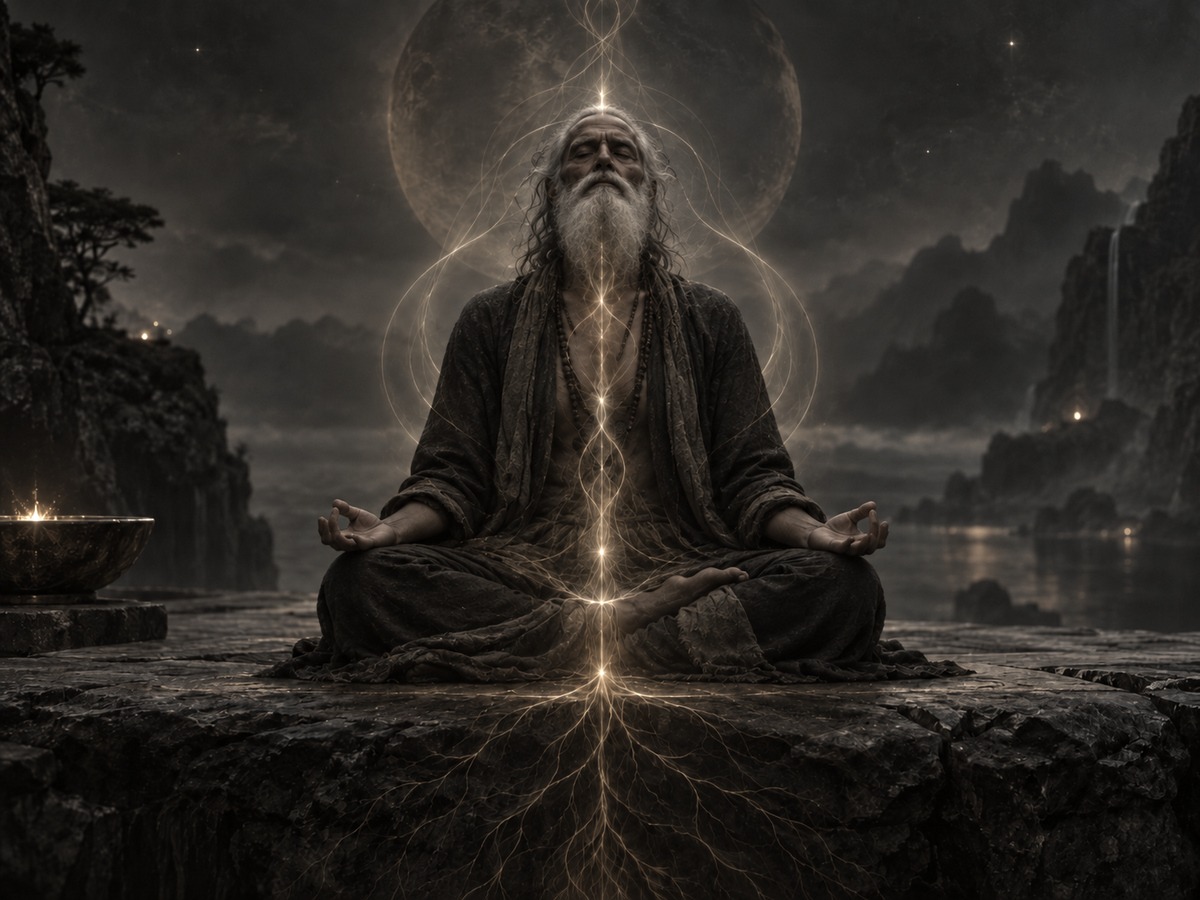
August 22nd 2013
The ancient practice of gesture, energy, grounding, and embodied awareness
For many people, the word mudra immediately brings to mind someone sitting in meditation, perhaps cross-legged, with the thumb and forefinger gently touching. That is certainly a mudra, but it is only the beginning. Mudras can involve the hands, eyes, tongue, mouth, throat, diaphragm, abdomen, pelvic floor, breath, spine, legs, concentration, or the entire body. To understand them only as hand gestures is to miss much of their original depth.
I came to understand mudras rather differently through my own practice of Himalayan Kundalini Kriya Yoga. The meditations could be extremely powerful. Breath, mantra, concentration, movement, stillness, and the deliberate direction of energy could produce states very different from ordinary consciousness. What became particularly important was what happened at the end. One did not simply finish an intense meditation, stand up, and walk away. Mudras were part of completing the practice. They helped ground the energy, contain it, settle it, and bring awareness fully back into the body. It was dangerous not to do so.
That experience gave me a much deeper understanding of the Sanskrit word mudrā, usually translated as a seal, sign, mark, or gesture. Of those translations, seal may tell us the most. A seal contains something. It establishes something. It prevents something from simply dissipating. In the spiritual physiology of yoga, mudras came to be understood as ways of working with the relationship between body, breath, prana, attention, and consciousness.
Historically this meaning was much broader than the hand mudras commonly taught today. Classical hatha yoga texts describe mudras involving abdominal contractions, pelvic and throat locks, inversions, tongue positions, gaze, breath retention, concentration, and whole-body configurations. Practices such as Mahamudra, Khechari Mudra, Shambhavi Mudra, Viparita Karani, Ashwini Mudra, Uddiyana Bandha, Mula Bandha, and Jalandhara Bandha all demonstrate how extensive the category could be. The boundaries between mudra, bandha, posture, breathing practice, and meditation were not always as tidy as modern yoga teaching sometimes makes them appear.
When speaking about mudras today, two languages tend to meet. The traditional language of yoga speaks of prana, nadis, chakras, kundalini, sushumna, awakening, grounding, sealing, and the movement of subtle energy. Contemporary science speaks instead of the autonomic nervous system, respiration, sensory feedback, proprioception, interoception, motor control, attention, muscular tone, and physiological regulation.
It is tempting to make these two languages compete with one another, but that may not be necessary. They developed from very different forms of investigation. Yogic traditions spent centuries observing human experience from within. Modern science observes and measures the organism through anatomy, physiology, electrophysiology, brain imaging, behavioral research, and statistics. They are not necessarily describing precisely the same thing, but neither are they completely unrelated.
Within traditional yoga, prana means considerably more than ordinary breathing. It refers to the vital movement or life force of the organism. Yogic subtle-body traditions describe channels called nadis, energetic centers known as chakras, and the central channel, sushumna. Kundalini traditions describe a latent spiritual force capable of awakening and moving through this subtle system. Within that worldview, mudras and bandhas were not simply symbolic gestures. They were practical methods intended to influence, contain, redirect, or stabilize prana.
Modern anatomy has not demonstrated physical structures corresponding literally to nadis or chakras, nor has science identified kundalini as a measurable physical energy. That is an important scientific fact. Yet it does not mean that the experiences described by practitioners are imaginary. Experiences of heat, pressure, expansion, vibration, movement, intense stillness, rising or descending sensations, altered body boundaries, and profound changes in consciousness are real experiences. What ultimately causes them, and how completely modern physiology can account for them, remains a more complicated question.
Modern science does increasingly support one of yoga's central intuitions: mind and body are inseparable. Change the breath and physiology changes. Change posture and sensory information changes. Alter the gaze and attention changes. Touch two fingers together and the nervous system receives tactile and proprioceptive information. Engage the abdomen or pelvic floor and the sensory and motor state of the organism changes. Bring sustained attention to the breath and the way the brain processes internal bodily information can also change.
One scientific concept particularly relevant here is interoception. Interoception refers to our perception and processing of signals from within the body: heartbeat, breathing, visceral sensations, temperature, muscular tension, and many other internal processes. Research increasingly connects interoception with emotional regulation, bodily awareness, and our fundamental sense of being embodied. Studies of mindfulness and contemplative practice suggest that training attention can alter the way people experience these internal signals.
The hands themselves are also neurologically significant. They occupy a substantial place in the sensory and motor systems of the brain and are among our primary instruments of communication. We grasp, point, protect, give, receive, reject, bless, comfort, and pray with our hands. Human beings were speaking through gesture long before anyone wrote a yoga manual. Research into gesture and embodied cognition supports the idea that hand movements participate in systems of meaning, action, communication, and attention.
So when the thumb touches another finger in a hand mudra, something physically real occurs. There is touch, pressure, sensory feedback, a stable bodily configuration, and an attentional anchor. If the gesture has also been repeated over many years in association with meditation or prayer, the organism may develop a powerful learned relationship with it. The gesture itself can begin to signal stillness.
None of this proves the traditional claim that a particular finger combination directs prana in a specific way, but neither does it make the gesture neurologically insignificant. There is a great deal occurring before we even reach the question of subtle energy.
Breathing adds another dimension. Many mudras are practiced in relationship with pranayama or deliberate breath regulation. Slow breathing has measurable effects on cardiovascular and autonomic physiology. Research has documented changes in heart-rate variability, respiratory sinus arrhythmia, cardiorespiratory coupling, baroreflex function, and autonomic regulation during slow breathing practices. Therefore, when mudra, breath, muscular engagement, and concentration occur simultaneously, there are unquestionably physiological changes occurring within the organism.
What modern science cannot yet tell us clearly is how much of the experience comes from the mudra itself, how much from breathing, how much from attention, how much from expectation, and how much emerges from all of these working together. Direct research isolating individual mudras is still comparatively limited. That is an important distinction. We do not need to exaggerate scientific evidence in order to recognize that these practices may have profound effects.
Meditation itself is also more complicated than the common idea that it simply calms the nervous system. Different forms of meditation can produce very different physiological states. Some strongly support relaxation and parasympathetic activity. Others produce greater alertness or sympathetic activation. Still others appear to combine deep relaxation with heightened awareness. This becomes especially relevant when discussing kundalini and kriya practices, which can be highly activating rather than merely sedating.
That description corresponds much more closely to my own experience of intensive Himalayan Kundalini Kriya Yoga. Some practices could produce tremendous stillness while simultaneously creating an experience of considerable energy. The system could feel extremely open, expanded, charged, or altered. Because of that, the ending of the meditation was not incidental. It was essential.
This is where grounding mudras became particularly important for me. After a powerful kriya meditation, I did not experience grounding as simply a relaxation exercise added to the end. It was part of completing the meditation itself. Something had been opened, intensified, or moved. Now the organism needed to settle. Attention needed to return to weight, gravity, touch, and bodily presence. The mudras helped with that movement.
Traditional yoga might describe this as sealing, directing, balancing, or grounding prana. A physiologist might describe aspects of the same period in terms of changes in breathing, muscular tone, proprioceptive input, tactile sensation, attention, and autonomic regulation. One language does not necessarily eliminate the other.
Science cannot presently demonstrate that a particular grounding mudra moves kundalini downward through a subtle channel. But science can readily support the proposition that deliberately altering touch, posture, breath, muscle engagement, gaze, and attention can change a person's physiological and psychological state after an intense meditation. Between those two descriptions lies a territory that remains extraordinarily interesting.
There is also an important spiritual principle here. Much spiritual language tends to move upward. We speak of higher consciousness, higher vibration, rising kundalini, the crown chakra, transcendence, ascension, and expansion. Yet human beings cannot live permanently upward. We have feet, legs, pelvises, bellies, bones, and gravity. We eat, sleep, work, wash dishes, speak to other people, love, grieve, age, and eventually die.
Perhaps mature spiritual practice therefore contains two movements rather than one. There is awakening, and there is embodiment. There is opening, and there is receiving. There is transcendence, and there is incarnation. There is expansion beyond the familiar sense of self, and there is the return of that awareness into ordinary human life.
Grounding after intense practice acknowledges both movements. The purpose is not merely to reach an extraordinary state of consciousness. It is to become capable of carrying something of that consciousness into an ordinary life.
Mudra can become part of that bridge.
There is also a simple mechanism of repetition at work. Imagine completing meditation every day for twenty years with the same posture, the same mudra, the same breathing, and the same intention. Eventually that gesture is no longer neutral. The body knows it. The hands take their position, the shoulders settle, the breath changes, attention gathers, and the organism recognizes that it is entering familiar territory.
This need not diminish the sacredness of the practice. Understanding that memory and nervous-system conditioning participate in a ritual does not make the ritual meaningless. Knowing how the eye works does not make a sunset less beautiful.
Mudras also carry an entirely different dimension: they communicate spiritual meaning. In Hindu and Buddhist sacred art, the position of the hands may express fearlessness, generosity, teaching, meditation, awakening, protection, or blessing. The Buddha touches the earth and an entire story of awakening is contained in that single gesture. Another figure raises an open palm and communicates reassurance. The resting hands of meditation suggest the cessation of grasping.
Here the body becomes language.
Indian classical dance develops this language still further. Hand gestures can represent animals, flowers, relationships, gods, emotions, actions, objects, and entire narratives. The dancer does not simply explain something. The body temporarily assumes its meaning.
And perhaps this is why mudras can feel strangely familiar even to someone who knows nothing about yoga. Human beings naturally place a hand upon the heart. We bow our heads. We join our palms. We open our hands when surrendering. We reach toward those we love. When words fail us, the body frequently takes over.
There is something ancient in this.
The body knows how to pray.
Not necessarily prayer directed toward a particular deity, but something more fundamental: reverence, surrender, gratitude, longing, compassion, silence. Sometimes the gesture comes before the explanation.
A mature approach to mudras does not require us either to accept every ancient claim unquestioningly or to dismiss everything that science has not yet measured. We can be precise about what is known. Mudras are an ancient and important component of yogic, tantric, Hindu, Buddhist, Jain, artistic, and ritual traditions. Historically they extend far beyond the hands. Traditional yoga explicitly connects many mudras with prana, kundalini, concentration, subtle-body practices, and spiritual transformation.
Science, meanwhile, demonstrates that posture, breathing, gaze, touch, muscular action, attention, and internal bodily awareness can influence human physiology and consciousness. Slow breathing affects autonomic and cardiovascular processes. Meditation can alter patterns of arousal and regulation. Contemplative training can influence interoceptive awareness. Gesture participates in systems of action, meaning, and communication.
What science cannot currently establish is that chakras or nadis exist as anatomical structures, that kundalini has been identified as a measurable physical force, or that the many specific therapeutic claims sometimes attached to individual mudras have been conclusively demonstrated.
There is no need to pretend otherwise.
For me, that uncertainty does not diminish the mystery. It actually makes the inquiry cleaner.
Perhaps my deepest understanding of mudra came not from memorizing what each gesture was supposed to mean, but from experiencing what happened after an intense meditation.
There had been breath, concentration, movement, energy, silence, and expansion. Then came the mudra.
The hands became still. The breathing settled. Awareness returned to gravity. The body came back into the foreground. Yet something of the meditation remained.
And perhaps that is the beautiful meaning of a seal.
We are not sealing the experience away.
We are allowing it to take form.
We are receiving it.
The extraordinary begins to enter the ordinary. The silence enters the body. The meditation enters the hands. The awakening comes down through the legs and meets the earth.
Perhaps spiritual practice is incomplete if all it teaches us is how to leave ordinary consciousness behind.
Eventually we have to return.
Not as though nothing happened.
But carrying something with us.
Then mudra is no longer simply a technique performed by the body.
The body itself becomes the mudra—a living seal between earth and consciousness, between the seen and the unseen, between the silence we enter and the life to which we return.
Nigel Lott teaandzen.org
Meditation Sans Frontieres 501 (C) 3 Registered Charity Tax EIN 81-3411835
May the work offered here serve peace, serve healing, serve remembrance, and serve the quiet dignity of being alive. May this sanctuary belong not to one person alone, but to the field of life itself.
And may all who encounter it feel, even for a moment, that nothing is missing and they are not alone.